
Dental Subscription for India - Replacing dental insurance with a Netflix model, and why the India opportunity is bigger
Most Indians only see a dentist when something hurts. One US startup figured out how to change that, and the same model will work better in India.

Methodology note: This analysis is based on publicly available information and personal visits to the businesses. Unit economics are estimated based on industry benchmarks for both markets. I’m not an expert or Healthcare consultant - I’m a researcher showing my work. If you spot flaws in the analysis, please tell me
My 70 yr old father recently had the unfortunate displeasure of having to visit a dentist 3 times in a row for 3 root canals and a filling. Fortunately he’s doing much better now, both physically and mentally. Besides the convo about his general wellbeing, I couldn’t help but wonder why dental insurance and regular cleaning isn’t a thing in India.
A google search told me it’s simply not common due to awareness and a focus on inpatient care. But I believe there’s an opportunity here in the Indian insurance landscape; a business model in the US that could be incredibly valuable to patients and businesses in India if done. It’s a superb mix of Indian Healthcare unit economics, scale, and quality of care.
01 — THE CONCEPT
Prevention over treatment. Subscription over insurance.
The dental subscription model flips the traditional dentist relationship on its head. Instead of paying per procedure and avoiding the chair until pain forces your hand, you pay a flat annual fee that covers unlimited preventive care. No insurance paperwork, no surprise bills, no upselling. The dentist’s incentive shifts from drilling to keeping your teeth healthy. That one change is what makes the whole thing work.
02 — THE US STORY
From broken incentives to a better model
The US dental system is structurally broken. Thankfully I have dental insurance, but nearly 70 million American adults don’t, and those who do face opaque reimbursements, annual caps, and from my many dentist visits, I can clearly see many dentists are quietly incentivised to find more things wrong with your teeth.
Two startups have attacked this differently. Tend launched in 2019 as the premium version. Think Netflix in the chair, Bose headphones, beautiful design, full-service dentistry across 25 clinics in New York, Atlanta, Boston and Washington DC, having raised $262M in total. Tend accepted insurance and offered everything from cleanings to implants. It is the luxury end of the model.
Wally went the other direction entirely. Founded in 2020 by Tyler Burnett after a dentist tried to sell him eight fillings on the spot, Wally’s premise is pure simplicity: $249 a year, no insurance, unlimited cleanings, exams, X-rays, and at-home whitening. No drills, no restorative work, no upselling. If you need a root canal, they refer you out. Across five locations in New York and New Jersey, Wally now has over 25,000 members who average three to four cleanings a year, nearly double the US national average.
Wally is smart. They remove every reason someone might avoid the dentist: cost uncertainty, fear of being upsold, complicated insurance, painful scraping. What remains is a product people actually want to use.
03 — THE NUMBERS
US unit economics

A single Wally location runs roughly 1,000 sq ft, staffed by three hygienists, three assistants and a dentist, treating 50 to 60 patients a day. At $249 per member, 1,000 members will generate $249,000 in pure recurring revenue before a patient sits in the chair. Practices with membership plans generate $372 per membership per year on average in subscription fees alone, with membership patients producing 17% more revenue than those covered by standard insurance.
The broader industry runs EBITDA margins of 25 to 35% of gross revenue, with the best-run practices hitting 40%+. The subscription model improves on this by eliminating insurance admin overhead entirely and dramatically improving visit frequency, both of which flow straight to margin.
04 — INDIA TRANSLATION
Same broken incentives. Bigger opportunity.
Here is why this memo starts in India, not the US. The problem Wally is solving exists in India too but at a much larger scale and for a completely different reason. In the US, dental subscriptions bypass a dysfunctional insurance middleman. In India, there is no meaningful insurance middleman to bypass. Only around 10% of India’s urban population has any dental coverage at all, and over 50% of Indians with dental problems still rely on unverified sources rather than seeing a dentist.
The problem here is not a broken system. The problem is that people simply do not go. The subscription model in India is not a workaround but a behaviour change product. That is a much bigger opportunity.
Three things make the timing feel right. India’s dental services market is valued at $2.5 billion in 2024, growing at 8% CAGR through 2030, with urban centres driving the majority of that growth. The 25 to 35 year old urban cohort - the same demographic driving Swiggy, Cult.fit, and Bombay Shaving Company — is increasingly spending on preventive health rather than reactive treatment. And average household healthcare expenditure including dental has increased by 12% over the past two years.
The Indian version needs to solve the same core problem: make preventive dental care so affordable, simple and non-threatening that someone who currently avoids the dentist becomes someone who goes three times a year. At Rs. 2,500 to 3,500 per year which is roughly the price of four Swiggy orders - that is a genuinely accessible price point for urban middle-class India.
On cost arbitrage: a dentist in India earns Rs. 3 to 6 lakh annually at the BDS level, compared to $150,000+ for a US hygienist-dentist team. A basic dental clinic setup in India runs Rs. 5 to 20 lakh for equipment, a fraction of US fit-out costs. The unit economics at a well-run single clinic can target 35 to 40% margins because the cost base is dramatically lower while subscription revenue is entirely predictable.
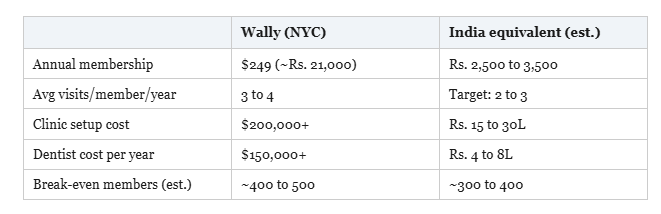
One unlock worth calling out: employer partnerships. The fastest path to 500 members is not individual acquisition - it is a corporate wellness deal where an employer subsidises or bundles the membership for employees. India’s large IT and professional services workforce is the perfect beachhead. A single deal with a 200-person company gets you there overnight.

05 — WHAT HAS TO BE TRUE
Ruthless assumptions
Patient acquisition is the hardest problem, not unit economics. Getting someone who has never voluntarily gone to a dentist to pay Rs. 3,000 upfront requires serious trust-building through word of mouth, employer tie-ups, and community presence. This is a marketing problem as much as a clinical one.
The no-drill, no-upsell positioning must be airtight. The moment a subscription clinic tries to upsell restorative work to its members, the core value proposition collapses. Refer out ruthlessly or lose the trust that makes the model work.
Location is everything. This model lives or dies on footfall and convenience. A subscription clinic near a corporate park or in a mixed-use development will outperform a standalone clinic on a side street. The patient needs to feel like going to the dentist is as easy as going to the gym downstairs.
A dentist co-founder or strong clinical partner is non-negotiable. This is a regulated healthcare business. Someone at the founding table needs to understand clinical operations, staff management and regulatory compliance, not just the subscription model. A business-only founder trying to hire dentists as employees will struggle.
Retention must be earned, not assumed. A member who pays Rs. 3,000 and never visits is short-term revenue and long-term churn. Building engagement through reminders, personalised care plans and genuine clinical relationships is the operating challenge that makes or breaks the economics.
Urban India’s preventive health appetite holds. The bet depends on 25 to 35 year old urban consumers choosing to spend on dental care before something goes wrong. That behaviour is growing but is still not the default, and remains thin outside Tier 1 cities.
06 — THE VERDICT
Go / No-Go
VERDICT: Conditional Go
Conditional Go, with eyes open on customer acquisition. The unit economics are genuinely attractive, the market gap is real, and the timing is right. This model doesn’t required the Indian population to behave differently. It just needs a specific type of urban Indian who already spends on health and wellness to redirect a small amount of that spend toward their teeth. That person exists in large numbers in Bengaluru, Mumbai, Hyderabad, and Pune today. The caveat is real: this is harder to start than a CPG brand or a restaurant concept. You need clinical co-founders, you are operating in a regulated space, and you are trying to change ingrained behaviour. But the person who wins this is not the one who opens the fanciest clinic. It is the one who makes going to the dentist feel like going to the gym - routine, affordable, and something you would actually tell your friends about.
SOURCES
1. Clerri — “Dental Membership Plan Statistics: 30 Data-Backed Insights” (2024)
2. Crain’s New York Business — “Glitzy dental startup raises another $72M” (Aug 2024)
3. Wally Health — carebywally.com; Opening Soon Podcast — “Reinventing Dentistry: Wally’s $249/Year Membership Model” (Oct 2025)
4. NJBIZ — “Wally Health subscription dental care arrives in NJ” (Aug 2025)
5. Crain’s New York Business — “Wally Health offers no-insurance basic dental care for an annual fee” (Jun 2023)
6. Clerri — “Dental Membership Plan Statistics” (2024); Decisions in Dentistry — “Dental Membership Plans Prove Better Than Insurance” (Nov 2025)
7. Overjet — “What Is the Average Dental Practice Revenue in 2025?”
8. Ken Research — India Dental Market Outlook to 2029
9. eHealth Magazine — “India’s Dental Industry: Emerging Trends, Innovations and Market Growth” (Mar 2025)
10. Nexdigm — India Dental Services Market Research Report (2024)
11. Ken Research — India Dental Market Outlook to 2029
12. PolicyBazaar — “Dentist Average Salary in India 2024-25”
13. Best Dental Deals — “Dental Clinic Setup Cost in India” (Nov 2025)
14. Benefit News — “How Wally Health is making dental benefits more comprehensive” (Nov 2025)